Industrial automation
PLC, HMI and SCADA engineering for machines, production lines and process installations: functional analysis, I/O architecture, sequences, interlocks, PID control, alarms, diagnostics, commissioning and modernization.
Industrial engineering services
Control Soft & Automation delivers engineering, integration and commissioning for industrial automation, PLC and SCADA systems, low-voltage electrical installations, industrial networks, energy management, condition monitoring and machinery functional safety.
PLC, HMI and SCADA engineering for machines, production lines and process installations: functional analysis, I/O architecture, sequences, interlocks, PID control, alarms, diagnostics, commissioning and modernization.
Engineering and programming for Siemens S7-1200, S7-1500 and distributed I/O, TIA Portal and operator interfaces, including machine modes, recipes, diagnostics and controlled migration of existing applications.
WinCC SCADA, real-time supervision, alarms, trends, historians, SQL/PostgreSQL data storage, reports, dashboards, OEE indicators, production records and industrial data acquisition.
Industrial low-voltage installations, machine feeders, power and control circuits, cable sizing, voltage-drop and short-circuit calculations, protection coordination, cable routes, protective conductors and equipotential bonding.
Distribution boards, MCC and automation cabinets, EPLAN schematics, bills of materials, wiring, terminals, circuit segregation, markings, workshop inspection, FAT and site integration.
Engineering and troubleshooting for PROFINET, PROFIBUS DP/PA, Modbus TCP/RTU, IO-Link, RS-232/RS-485 and compatible industrial gateways, with documented topology and addressing.
Industrial Ethernet, UTP/FTP/STP structured cabling, fibre-optic links, industrial switches and routers, VLAN segmentation, VPN remote access, OPC UA, MQTT and edge-gateway integration.
Integration of 4–20 mA, pulse, digital, HART and fieldbus instruments, including sensor range, scaling, galvanic isolation, shielding, calibration requirements and end-to-end loop verification.
Custom network calculations and measurement of voltage, current, power, power factor, harmonics, THD and imbalance, with engineering assessment of reactive-power compensation and harmonic mitigation.
Sub-metering, load profiles, machine and line consumption, specific energy consumption, baselines, peak-demand analysis and energy-efficiency studies supported by ENERGRAFICS.
Selection and integration of direct-on-line, star-delta, soft-starter and variable-frequency-drive solutions, including protection, EMC, motor cabling, parameters, communications and process interlocks.
Machine risk assessment, safety-function definition, PLr/PL and SIL engineering where applicable, safety sensors, logic and actuators, SISTEMA documentation, validation and functional-safety testing.
Technical documentation supporting machinery conformity assessment: risk assessment, safety validation records, electrical documentation, instructions and machine-specific technical files.
Vibration and temperature monitoring, DE/NDE measuring points, trends, alarms, FFT analysis where applicable, asset history and maintenance-oriented reporting through CSA VibraThink.
Thermal inspection of electrical panels, connections, cables and loaded equipment, correlated with operating load, ambient conditions, electrical measurements and maintenance history.
Integration of valves, cylinders, pressure and position sensing, safe exhaust and residual-energy considerations, plus hydraulic pumps, valves, actuators, pressure/flow supervision and PLC control.
Brownfield modernization, controlled migration, interface verification, FAT/SAT, commissioning, optimization, technical documentation, operator training and support for critical industrial applications.
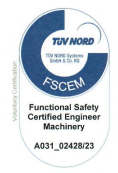
TÜV NORD certified competence
Machinery Safety and CE technical-documentation services are technically coordinated using individually certified professional competence in machinery functional safety.
Certificate A031_02428/23Technologies and engineering domains
TECHNICAL REFERENCE
Design and execution start from the machine, the process and the operating environment. These technical references complement our core services and help define a clear project specification. Configuration, deliverables, required authorizations and project availability are established explicitly in the technical offer.
Machine feeders and low-voltage distribution are engineered according to installed loads, duty cycle and available routing. Cable cross-section is not selected only from motor power: current-carrying capacity, installation method, grouping, ambient temperature and voltage drop all matter.
The work boundary can include cable trays, power and control circuits, protective conductors and equipotential bonding. Continuity, insulation and protection checks are defined for the actual installation and form part of commissioning preparation.
An electrical panel must be safe to operate and maintain, not merely fit inside an enclosure. Distribution boards, automation cabinets and motor-control centres require coordinated protection, circuit segregation, wiring, terminals, ventilation and service access.
Single-line and detailed schematics, EPLAN design, bill of materials, cable lists and markings should describe the delivered configuration. Workshop inspections and FAT precede site integration, while SAT confirms operation under the agreed site conditions.
Machine automation starts from operating sequences, I/O lists and operating modes. PLC and HMI software, process interlocks, PID loops and alarms should implement those requirements. SCADA adds supervision, trends, history and reporting; integration with an existing DCS requires clear interface and control responsibilities.
Modernization and retrofit projects may use Siemens S7-1200 or S7-1500 controllers, ET 200 distributed I/O, TIA Portal and WinCC. Brownfield migration requires verification of available software, hardware compatibility and shutdown windows rather than assuming direct component replacement.
For food and beverage production lines, the functional specification should also define the relationship between conveying, dosing, weighing and process operations. Required sequences and records are established for the actual product and installation.
The choice between PROFINET, PROFIBUS DP/PA, Modbus TCP and Modbus RTU starts from device interfaces and process requirements. RS-232 and RS-485 are physical communication interfaces, not protocols. IO-Link integrates compatible sensors and actuators through the appropriate master.
An industrial gateway can bridge different segments but does not remove the need to verify registers, data types and update times. EtherNet/IP or CANopen support must be confirmed at device level. PLC–SCADA troubleshooting includes topology, addressing, cabling and diagnostics.
Industrial low-current work and structured cabling must consider electrical interference and the installation environment. UTP, FTP or STP cabling, Cat6/Cat6A components, patch panels and racks should be selected as a complete system with documented routing and shielding.
Fibre-optic links can connect industrial areas or buildings through compatible media and SFP modules. Fibre type, link length and optical budget are coordinated, while industrial switches, routers and media converters are documented in the network architecture.
OT networks support machine operation and have different priorities from office networks. VLAN segmentation, industrial firewall rules and VPN access should be designed with the infrastructure owner. Internet connectivity should not directly expose PLC or SCADA assets.
For Industrial IoT, edge gateways can collect and forward data to authorized applications. OPC UA and MQTT are selected according to available interfaces, authentication and the data model. Asset inventory, backups and access control complete the architecture.
Custom electrical calculations start from the single-line diagram, supply source, cables and loads. Voltage drop, short-circuit currents, protection sizing, coordination and selectivity are evaluated using documented assumptions and project data.
A power-quality analyser can record voltage, current, power, power factor, harmonics and imbalance within its measurement capabilities. Reactive-power compensation and harmonic filtering should be evaluated from measurements rather than from generic assumptions.
Monitoring consumption by line, machine and shift helps separate production demand from idle consumption. Sub-metering, load profiles and specific consumption related to production enable meaningful comparisons and deviation detection.
Energy optimization can address peak demand, reactive energy, idle operation, compressed-air losses or process scheduling. Savings estimates should be based on measured baselines, operating assumptions and the technical limits of the installation.
Industrial measurements may use 4–20 mA, digital inputs, pulses, HART or fieldbus communication. Sensor range, process connection, power supply, galvanic isolation, shielding and scaling must be coordinated with the PLC or acquisition system.
A measurement loop should be checked from the physical sensor to the value displayed in HMI, SCADA or historian. Calibration requirements and uncertainty depend on the application and the instrument class.
Data acquisition begins with a tag list that defines source, engineering unit, sampling or event rules and expected quality. Historians and SQL/PostgreSQL databases can retain trends, alarms and production information when retention and access requirements are defined.
Dashboards, OEE indicators and forecasts are useful only when the underlying data is consistent. Missing values, duplicate timestamps, counter resets and changes in machine state should be handled explicitly before higher-level analytics.
Motor-control architecture depends on the process, starting torque, operating range and safety requirements. Direct-on-line starters, star-delta, soft starters and variable-frequency drives solve different technical problems.
VFD integration includes power sizing, protection, motor cable, EMC, control mode, parameters, communication and process interlocks. Commissioning should verify both electrical operation and the behaviour of the driven machine.
Thermal imaging can reveal abnormal temperature patterns in electrical panels, connections, cables and loaded equipment. Interpretation must consider load, ambient conditions, emissivity and the geometry of the measured surface.
A thermal image alone does not establish the root cause. Findings should be correlated with electrical measurements, inspection history and safe maintenance procedures before intervention priorities are set.
Corrective, preventive and condition-based maintenance require different information. Diagnostics combines alarms, measurements, machine history and inspection results to identify the most likely causes before parts are replaced.
Retrofit work should document existing functionality, interfaces and safety functions. A controlled migration plan reduces commissioning risk and preserves serviceability after the modernization.
Machinery safety starts from machine limits, hazard identification and risk estimation. Safety functions are then defined and implemented through suitable sensors, logic and actuators, with required PLr or SIL determined for the application.
Validation records, SISTEMA documentation, electrical diagrams, instructions and other technical documents must reflect the machine actually delivered. CE conformity is a documented process, not a label added at the end of a project.
Pneumatic circuits include air preparation, valves, cylinders, sensors, pressure control and safe exhaust functions. PLC integration requires a clear I/O and sequence definition as well as consideration of residual energy and failure states.
Air consumption, pressure drop and actuator force should be checked for the actual cycle. Safety-related pneumatic functions require appropriate architecture and validation.
Hydraulic systems combine pumps, valves, cylinders or motors, filtration, reservoirs, pressure and temperature supervision. Automation must coordinate hydraulic behaviour with machine sequences and protection functions.
Pressure, flow, stored energy and contamination are central to reliability and safety. Instrumentation, electrical control and hydraulic schematics should be reviewed together during design or modernization.